My heroines may wear medieval silks and furs, but I’m definitely a 21st century fashionista. When I want to escape my writing problems, I grab a fashion magazine and dream of looking good in sky-high heels and a smokey eye.”
Of course, in my real world, I wear leggings and a tee shirt and the only thing I own with the Chanel logo is a bottle of nail polish. (Graphite, this season’s hot shade.)
And once I started writing historicals set on the Scottish Border, my fictional world became even less fashionable. Border Reivers were known for many things. Fancy clothes were not among them.
So it is not very often that my fictional and my real world intersect, fashionwise.
But this month, I opened Vogue magazine and there was a picture of Stella Tennant, English model, posing in the middle of a stream in Liddesdale.
Where the most notorious Reivers lived.
Including the family in my upcoming series.
You can see the picture that stopped me in my tracks at the photographer's website: http://bentoms.blogspot.com/2011/08/stella-tennant-christopher-kane.html
It seems (who knew?) that Scotland is having a fashion moment. Article and pictures followed Stella (who was born in the Scottish border burg of Oxnam and still lives in the area) on a tour of the high fashion hot spots, an “insider’s introduction to the origins of tweed, cashmere, tartan, and kilts.”
Ms. Tennant was brought up on a sheep farm, so I guess she knows more about cloth production than the average granddaughter of a duchess. And she’s using her connections to promote Scottish made goods amount the high fashion set. Chanel and Prada now have items made in Scotland and, I discovered, Hermes and Louis Vuitton have been doing for years. Pringle of Scotland even shows during London’s fashion week and rated a highlight in Bazaar magazine’s coverage for its “enchanting hybrids both functional and far-out.”
To bring fashion back to history, the wool trade was very important to the Scots-English Borders as far back as medieval times. Originally, sheep fleece was sent to Flanders where weavers, such as my heroine in INNOCENCE UNVEILED, made it into prized wool. The family in HIS BORDER BRIDE also raised sheep, which provided virtually the only source of outside currency.
So I guess I must just be a fashion magnet, drawn to the places that only the stylish know. And I guess I could make the case that my Flemish and Scots heroines were, in a roundabout way, in the rag trade.
What about you? Are you interested in clothes, historic or modern? Any favorites you’ve read about in historical romance?

Tuesday, September 27, 2011

Wednesday, September 21, 2011
Waterloo Days

Valiant Soldier, Beautiful Enemy is in bookstores this month. This last book in my Three Soldiers series, takes place, in part, in Brussels in the days before Waterloo. Brussels is where Captain Gabriel Deane finds the woman he and the two other officers rescued at Badajoz and it is in Brussels where Gabe’s and Emmaline’s love story really begins…and almost ends.
After Napoleon was exiled on Elba, Europe opened up again for the British, who’d had to give up their Grand Tours of the Continent’s grand cities. Many British from aristocratic families, but lacking aristocratic fortunes moved to Brussels where they could live in luxury at low cost. When Napoleon escaped from Elba and returned in triumph to Paris, the British army amassed at Brussels, anticipating a march into France to do battle with Napoleon’s new army. Consequently in the spring of 1815, Brussels was brimming with British.
In June 1815, Miss Charlotte Waldie (married name Eaton) wrote a memoir, Waterloo Days: The Narrative of an Englishwoman resident of Brussels. Accompanied by her brother and younger sister, Charlotte traveled to Brussels, arriving the day of the Duchess of Richmond’s ball.
Charlotte found a city bustling with British soldiers, civilians, and other foreigners. She described it as lively, gay, and festive, “… everything spoke of hope, confidence, and busy expectation.” That very night her sleep was interrupted by the bugle’s call to arms. She rose and went outside to witness the hasty departure of the soldiers, marching off to battle.
She wrote:
“Numbers were taking leave of their wives and children, perhaps for the last time, and many a veteran's rough cheek was wet with the tears of sorrow. One poor fellow, immediately under our windows, turned back again and again, to bid his wife farewell, and take his baby once more in his arms; and I saw him hastily brush away a tear with the sleeve of his coat, as he gave her back the child for the last time, wrung her hand, and ran off to join his company, which was drawn up on the other side of the Place Royale.”
The next day she, her brother and sister heard the cannonade at Quartres Bras and received mixed messages about the fate of the army, most indicating that the British were overwhelmed by the French. The next day, Charlotte and her party joined the numbers of British civilians fleeing Brussels. Like so many others, they traveled to the relative safety of Antwerp.
On June 18 they again heard the cannons and experienced “the dreadful, the overwhelming anxiety of being so near such eventful scenes, without being actually engaged in them; to know that within a few leagues the dreadful storm of war is raging in all its horrors, and the mortal conflict going forward which is to decide the glory of your country, and the security of the world.”
The next day, wagons full of wounded soldiers poured into Antwerp and the news was everywhere that Wellington’s forces could not overcome the French. Eventually, however, they heard that Wellington had won the battle.
Then the wounded poured into Antwerp, many unable to find shelter, merely lay in the streets.
Charlotte wrote:
“If such were the horrors of the scene here, what must they be on the field of battle, covered with thousands of the dead, the wounded, and the dying! The idea was almost too dreadful for human endurance; a there nd yet were those of my own country, and even of my own sex, whom I heard express a longing wish to visit this very morning the fatal field of Waterloo!”
A month later, Charlotte and her brother and sister visited the battlefield. She had this to say:
“I stood alone upon the spot so lately bathed in human blood—where more than two hundred thousand human beings had mingled together in mortal strife: I cast my eyes upon the ruined hovels immortalised by the glorious achievements of my gallant countrymen. I recalled to mind their invincible constancy—their undaunted intrepidity—their heroic self-devotion in the hour of trial—their magnanimity and mercy in the moment of victory: I cast my eyes upon the tremendous graves at my feet, filled with the mortal remains of heroes.”
Charlotte ends her memoir with her return to England, writing:
“I returned to my country after all the varying and eventful scenes through which it had been my lot to pass, more proud than when I left it of the name of....An Englishwoman.”
I have long been captivated by the battle of Waterloo and the men who fought it, but for the purposes of writing about my heroines, reading Charlotte’s memoir gave a whole other perspective to the battle.
Is there a moment in history that captivates you?
There is still time to get your copy of Valiant Soldier, Beautiful Enemy. If you have been following my Three Soldiers series, you will also be pleased to know that Claude’s story is told in October’s Harlequin Historical Undone ebook short story, The Liberation of Miss Finch.
Tuesday, September 20, 2011
Too early for Christmas shopping?

This week I received a box full of advance copies of my latest book, "Gift-Wrapped Governesses", so thought I'd like to share the cover picture with you.
I just love the mischievous expression on the little girl's face as the boy hands her a present.
My story is called "From Governess to Christmas Bride".
The anthology also contains stories featuring governess heroines, from Sophia James and Marguerite Kaye.
Having read both their stories with great enjoyment I'm in the mood to start my Christmas shopping.
And it's way too early!
Monday, September 19, 2011
Visiting Ireland
Last month, I spent a week on the Emerald Isle -- one day in Dublin and the rest visiting friends near Derry, in the north of Northern Ireland. This was my first visit, and it was absolutely wonderful. In Dublin, we went to the archaeology exhibits of the National Museum of Ireland, with its collection of Bronze Age gold objects, Celtic metalwork, Viking artifacts...wow. I was jet-lagged and sleepy, so I missed some exhibits I'm longing to see. I hope to return and see more of the attractions of Dublin.
Here is the view from a hill near where we stayed in Northern Ireland -- so peaceful and pastoral. The air was incredibly fresh, cool, and pure.

We spent a day in Derry (aka Londonderry), which was the site of Bloody Sunday, also known as the Bogside Massacre, in 1972. The old city wall of Derry is still intact. We walked all the way around it, taking pictures and getting history lessons from the various placards. Much of it was familiar to me, but being in Derry made it all the more real. Here is a photo from the wall of Derry. This photo -- the cannon, the wall, and the houses crowded below -- makes my stomach knot up. There's a lot of very unhappy history here.

We walked across the beautiful new Peace Bridge, which spans the River Foyle and both literally and symbolically connects the Catholic and Protestant communities in peace.

Ireland is an astonishing place. I hope to blog about it again soon -- hopefully with a recipe for Irish Soda Bread.
Here is the view from a hill near where we stayed in Northern Ireland -- so peaceful and pastoral. The air was incredibly fresh, cool, and pure.
We spent a day in Derry (aka Londonderry), which was the site of Bloody Sunday, also known as the Bogside Massacre, in 1972. The old city wall of Derry is still intact. We walked all the way around it, taking pictures and getting history lessons from the various placards. Much of it was familiar to me, but being in Derry made it all the more real. Here is a photo from the wall of Derry. This photo -- the cannon, the wall, and the houses crowded below -- makes my stomach knot up. There's a lot of very unhappy history here.
We walked across the beautiful new Peace Bridge, which spans the River Foyle and both literally and symbolically connects the Catholic and Protestant communities in peace.
Ireland is an astonishing place. I hope to blog about it again soon -- hopefully with a recipe for Irish Soda Bread.
Tuesday, August 23, 2011
Bookshelf Makeover Needed. Help!
As I am about to embark on a remodeling project, I’ve been thinking about how to (re)organize my books.
Once upon a time, they WERE organized. Research books and non-fiction grouped by time period. The biographies were in alphabetical order by name of the subject. The “keepers” from my childhood (Betsy-Tacy, The Little Colonel, Cherry Ames) had their own proud place. Travel books and maps where separate and close to the Really Useful tomes on How To Fix a Toilet and First Aid for Dummies.
There was a section for poetry and one for those beautiful books on art. Inspirational books were neatly shelved. And writing craft books were handy, along with a dictionary, thesauruses (yes, more than one), and a book on when specific words came into use. (Imperative to know when you write histor ical fiction.)
There was a separate shelf for signed books written by my friends. I had a “keeper” shelf (literally) and it was (symbolically) the highest shelf – books I would aspire to write.
There was even an “incoming” shelf for books I had purchased and not yet read, easy to peruse whenever I finished a book and was ready to choose the next.
This list is not exhaustive, but you get the idea. Once, in a former life, I was Organized.
Time passed.
I sold my first book.
I started a shelf of the books I had written. (One copy each, including the foreign editions.)
I had more friends who were writers. They sold more books. I bought them.
I learned about more books that I wanted to read. I found more keepers.
I went to writers conferences. I bought more books. I was GIVEN more books.
I changed time periods. I had ideas for books I hadn’t sold yet. My research library grew accordingly.
My deadlines grew shorter. My reading time briefer. “Incoming” no longer had its own shelf. I doubleshelved paperbacks. Research books for books I intended to write someday were relegated to bags on the floor in order to keep the shelves available for research books about projects I was actually writing. I had books stashed anywhere there was a flat surface, including on top of and underneath chairs.
And, let’s be honest – the floor of my office. (And yes, that is an actual picture of an actual bookshelf in my office.)
So now, as I am forced to box it all up and start over, I’m wondering how the rest of you do it. How do YOU organize your reading material?
Can these shelves be saved?
Once upon a time, they WERE organized. Research books and non-fiction grouped by time period. The biographies were in alphabetical order by name of the subject. The “keepers” from my childhood (Betsy-Tacy, The Little Colonel, Cherry Ames) had their own proud place. Travel books and maps where separate and close to the Really Useful tomes on How To Fix a Toilet and First Aid for Dummies.
There was a section for poetry and one for those beautiful books on art. Inspirational books were neatly shelved. And writing craft books were handy, along with a dictionary, thesauruses (yes, more than one), and a book on when specific words came into use. (Imperative to know when you write histor
 ical fiction.)
There was a separate shelf for signed books written by my friends. I had a “keeper” shelf (literally) and it was (symbolically) the highest shelf – books I would aspire to write.
There was even an “incoming” shelf for books I had purchased and not yet read, easy to peruse whenever I finished a book and was ready to choose the next.
This list is not exhaustive, but you get the idea. Once, in a former life, I was Organized.
Time passed.
I sold my first book.
I started a shelf of the books I had written. (One copy each, including the foreign editions.)
I had more friends who were writers. They sold more books. I bought them.
I learned about more books that I wanted to read. I found more keepers.
I went to writers conferences. I bought more books. I was GIVEN more books.
I changed time periods. I had ideas for books I hadn’t sold yet. My research library grew accordingly.

My deadlines grew shorter. My reading time briefer. “Incoming” no longer had its own shelf. I doubleshelved paperbacks. Research books for books I intended to write someday were relegated to bags on the floor in order to keep the shelves available for research books about projects I was actually writing. I had books stashed anywhere there was a flat surface, including on top of and underneath chairs.
And, let’s be honest – the floor of my office. (And yes, that is an actual picture of an actual bookshelf in my office.)
So now, as I am forced to box it all up and start over, I’m wondering how the rest of you do it. How do YOU organize your reading material?
Can these shelves be saved?
Wednesday, August 17, 2011
Peterloo and the Fight for Freedom
 Yesterday, August 16, was the 192nd anniversary of The Peterloo Massacre. On that date in 1819, in St. Peters Field, Manchester, England, 60,ooo peaceful demonstrators gathered to protest the Corn Laws, the poor economic conditions, lack of suffrage and other social problems. The main speaker was the famous political orator, Henry Hunt. The local magistrates became frightened at the size of the crowd and read The Riot Act, but in a crowd of that size, few heard it. The local Yeomanry were ordered to disperse the crowd and they rode through, hacking at the people with their sabers. The crowd panicked and Hussars were also called in to restore order. In the end, 18 protesters were killed, including a woman and child, and as many as 700 were seriously injured.
 Speakers and organizers were arrested (though ultimately charges of high treason were dropped), but also arrested were journalists who reported on the event and published their accounts in newspapers.
As appalling as it might seem to the Western World now, freedom to protest, freedom of speech and of the press, were outlawed in 1819. Earlier episodes of social unrest convinced Lord Sidmouth, the Home Secretary, that revolution was in the wind. (Remember, the French Revolution would have been fresh in the minds of the British Peerage). Parliament passed the Gag Acts suspending Habeas Corpus, banning seditious meetings and the printing of seditious documents. This meant anyone could be arrested and held without charges, and it meant the limiting of free speech and a free press. Quite extreme measures. After Peterloo, as the episode became known, Parliament passed the even more repressive Six Acts.
Even so, many historians consider Peterloo a turning point in the fight for freedom and political reform in Great Britain. The horror of the government attacking peaceful citizens changed public opinion and ultimately led to the right of the citizenry (alas, men only for several years) to vote.
 In my last book, Chivalrous Captain, Rebel Mistress, social protest played an important part in what kept my hero and heroine apart and what ultimately gave them their happy ending. My latest book, the last in my Three Soldiers Series, Gallant Soldier, Beautiful Enemy has a French connection. It is available now from eHarlequin and will be in bookstores and other online vendors by Sept 1.
 What books have you read which involve the Peterloo Massacre? It would make great drama!
Monday, August 01, 2011
The Wanton Governess

I'm totally exhausted, which is definitely the wrong way to be on release day. Pompeia, the heroine of my new release, was a joy to write, and I was hoping to post something more than just an excerpt, but I'm falling asleep as I type... so here goes.
Harlequin Historicals publishes two short e-novellas in the Undone series each month, and this month one of them is mine! It's a Regency romance called The Wanton Governess. I simply love the cover, because it conveys the heroine's nature so well. Here's a brief blurb:
In exchange for a few days’ shelter, dismissed governess Pompeia Grant pretends to be the wife of a man who spurned her years earlier. James Carling, the man in question, is in America, so he’ll never know.
And it’s only for a couple of days.
And she’s helping a friend, so she’s doing a good deed…
But the next day, James comes home.
And now the excerpt:
“What in hell’s name were you thinking?”
At this furious bellow all the ladies froze, then gaped. “Who was that?” Clarabelle faltered.
Pompeia rose in horror. She would know that enraged shout anywhere. She had heard it only once before, and she would never forget it.
But this time it was surely directed at her.
Footsteps hammered on the staircase, and her heart abandoned itself to terror. She had to run. She had to flee.
No! She had to do something.
“James, wait!” That was Sally’s voice. “Please, just let me—”
“James wasn’t supposed to be home yet,” Clarabelle moaned, and meanwhile the footsteps pounded down the passage.
Think, think! There must be some way to avert disaster. Not to Pompeia herself—that was impossible—but to Sally, to whom the vouchers for Almack’s meant so much. But there wasn’t time, because it would mean convincing Sir James to talk to her privately before exposing the deception. It would mean making him want to. Inexorably, the footsteps approached the drawing-room doorway.
I know how to make a man want to, said the Wanton Within.
Not that! Pompeia’s rational mind screamed. Not now! But after a second’s furious pause, she realized that for once the Wanton might be right. She got her feet moving and went straight for the door.
Too late.
He came into the room like a thunderstorm. It was James indeed, older, broader and even more beautiful than four years ago, from his dark, wavy hair and grey eyes to his well-worn leathers. The Wanton Within applauded, but mostly, Pompeia cringed. She closed her eyes, desperate to compose herself. A babble of voices roiled around her, but she was poised only for his, for the fatal words exposing her as a fraud, commanding her to leave.
Open your eyes, said the Wanton. Look at him.
She did. He stared back, the anger slowly draining from his features, surprise taking its place.
That’s a good start, the Wanton said. Now, let your eyes do the talking. But Pompeia had done that once before to Sir James—accompanied by words that permitted no misunderstanding—and received a stinging refusal.
That was then; this is now, the Wanton insisted. Smile, for pity’s sake!
Pompeia felt her lips tremble into a travesty of a welcome.
Sir James’s mouth quirked the tiniest bit in response. “Pompeia,” he said.
She forced her tongue into motion. “J-James.”
“Unbelievable.” Slowly, he shook his head. “Oh, Pompeia.” His eyes rested on her, warmly approving. No, wickedly so.
This was astonishingly different from the last time they’d met, when the chill in those eyes had made even the Wanton cower. No, particularly the Wanton, who had gone into hiding for quite a while after that.
What had happened to change things?
Ah. James did know about Pompeia’s disgrace, just as she’d assumed. And, in the way of all men, he anticipated that she would willingly be just as disgraceful with him.
Yes! Do let’s! Just this once! the Wanton said.
The Wanton Governess is available at e-Harlequin, Amazon, Barnes and Noble, Books-a-Million and possibly other places where e-books are sold. So is this month's other Historical Undone, Unlacing the Lady in Waiting by Amanda McCabe, which takes place during the Renaissance in Scotland.
Happy reading to all! (And to all a good night!)

BULLETIN!! Amanda McCabe just sent me her cover art and blurb, so here goes:

Scotland, 1561
Lady Helen Frasier thought Highlanders were barbaric—until she shared an intimate encounter with her betrothed, James McKerrigan. Though their families were enemies, the Highland lord roused a surprising passion in Helen. Then she was chosen to become a lady in waiting to the queen, and their engagement was broken.Now, Helen has returned to Scotland and her jilted lover, who has vowed to take revenge and claim his promised bride....
Thursday, July 28, 2011
Inspiration can strike you anywhere...

People are always interested in where writers get the inspiration for their stories. For me the ideas can come from anywhere. The idea for "To Catch A Husband" grew out of living on the Yorkshire/Lancashire border and being surrounded by old mills. The small mill towns around me are still full of reminders of the past, the small stone houses with their rows of upstairs windows, giving light into the room where the weaving would be done. The loom would clack away throughout the daylight hours weaving cloth and providing a living for the family, the Piece Hall in Halifax where the cloth merchants used to bring their cloth (or "pieces") to sell,. and Quarry Bank Mill just south of Manchester, now a fascinating museum with working machinery that shows just how tough (and noisy) life in the mills was in the 18th and 19th centuries.
For my next book, "The Dangerous Lord Darrington", inspiration came when I was staying with a friend in Sussex and she took me to see Michelham Priory pictured above).
We went to see it on a sunny summer's day, but I immediately imagined what it would be like to approach this ancient building on a dark and stormy night and have the steeply gabled roof towering over you. I wasn't planning to write a gothic novel, but I did think it would be a splendid setting for a mystery.
I decided to set my own house, the Priory, in the wilds of Yorkshire. In the opening scenes of the book, Guy Wylder (Lord Darrington) brings his wounded friend to the house on a wet and windy evening, when the house looks at its most gloomy and menacing. Then, in the dark reaches of the night he hears strange noises and uncovers a family secret.
Of course, the house is also the family home of my heroine, Beth Forrester, so it is not really as dark and threatening as it first appears, but the first images give the story a terrific impact and set the scene for a fast-paced adventure that sees Beth and Guy thrown together in a desperate search for justice.
But, as I said at the beginning, inspiration can come from anywhere. I recently had a great holiday on Exmoor, which has provided me with ideas for my next couple of books…..watch this space!
For my next book, "The Dangerous Lord Darrington", inspiration came when I was staying with a friend in Sussex and she took me to see Michelham Priory pictured above).
We went to see it on a sunny summer's day, but I immediately imagined what it would be like to approach this ancient building on a dark and stormy night and have the steeply gabled roof towering over you. I wasn't planning to write a gothic novel, but I did think it would be a splendid setting for a mystery.
I decided to set my own house, the Priory, in the wilds of Yorkshire. In the opening scenes of the book, Guy Wylder (Lord Darrington) brings his wounded friend to the house on a wet and windy evening, when the house looks at its most gloomy and menacing. Then, in the dark reaches of the night he hears strange noises and uncovers a family secret.
Of course, the house is also the family home of my heroine, Beth
 Forrester, so it is not really as dark and threatening as it first appears, but the first images give the story a terrific impact and set the scene for a fast-paced adventure that sees Beth and Guy thrown together in a desperate search for justice.
But, as I said at the beginning, inspiration can come from anywhere. I recently had a great holiday on Exmoor, which has provided me with ideas for my next couple of books…..watch this space!
Sarah Mallory
Tuesday, July 26, 2011
Ancient Words, Modern Meanings
I hope some of you saw the blogs Harlequin posted on the peregrine falcon family that nested within sight of the office windows in Toronto. The falcons, who mate for life by the way, had a baby bird and Harlequin staff named it Harlequin, or “Harlie,” for short. (Here’s a peak at the saga: http://harlequinblog.com/2011/06/harlequin-peregrine-cam/)
It’s a perfect romance.
I wish this camera had been in place when I was writing my last book, because the heroine of HIS BORDER BRIDE was an avid falconer who also raised a baby bird and trained it to hunt. This was not done during medieval time and still not recommended by many experts because the bird becomes too “imprinted” upon humans, potentially losing its natural hunting instincts.
As I studied the ancient sport of training raptors (birds like
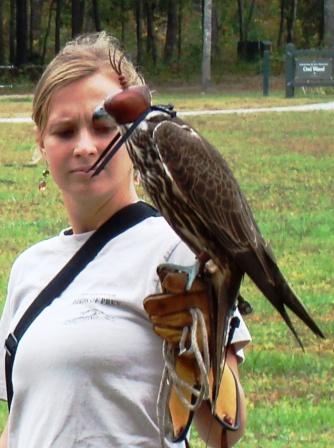 falcons and eagles) to hunt prey on command, I also learned some of the specialized terminology of the sport. I was surprised to find how many words from falconry are used today in a totally different context. Here’s a sample of ones I suspect most people use without knowing their origin:
Fledgling: A fledgling is a young falcon that has just grown it’s “flight feathers.” (To “fledge” is to take the first flight.) Today, a fledgling is a newbie. It is also used as an adjective, e.g. a fledgling novelist.
Codger: Originally “cadger.” This was a person who carried the cadge, a portable perch which could carry several birds, into the field for the hunt. Usually, the cadger was an old falconer. Hence, codger now means an old person.
Hoodwinked: We use it to say someone was fooled, but originally, it literally meant putting a hood over the falcon’s head. This made the bird think it was night and calmed it. This was done to prevent the bird from being disturbed or, for example, so the hunter could take the prey away without the bird knowing.
Gorge: This was originally the bird’s crop, a sort of sack in the bird’s throat in which food is stored before swallowing. Hence, to gorge, or overeat.
Mews: This was originally housing for falcons. Later, it became attached to the place where horses were kept, and then to a small of houses converted from stables, or made to look like stables.
Boozing: A bird drinking water, sometimes to excess, was said to be “bowsing.” Hence, drinking…other things…to excess.
Haggard: A haggard was a bird caught in the wild as an adult, older than a fledgling. The word evolved to indicate something or someone who looks well-worn.
Are any of these new to you? Or do you have words to contribute, from falconry or not, that have dramatically changed in meaning through the years?
P.S. The picture was taken at the South Carolina Center for Birds of Prey, when I was doing research for the book. This falcon is (dare I say it?) hoodwinked.
Blythe Gifford
HIS BORDER BRIDE, May 2010
Wednesday, July 20, 2011
The Regency Governess
 One of this month’s Harlequin Historicals is Christine Merrill’s Dangerous Lord, Innocent Governess, reminding me that the governess has been a popular heroine in Regency Historical Romance. So popular that I’m even considering a governess heroine for my next book.
Perhaps literature’s most iconic governess heroine was Jane Eyre. Charlotte Bronte (and her sisters) knew first hand about the life of a governess. They each worked briefly as such. Jane Eyre’s experience as a governess had gothic overtones (as does Christine’s Dangerous Lord, Innocent Governess). But we also learn about the life of a governess from Jane Austen. In Emma, Austen shows both the best of a governess’s life and the worst. Emma’s beloved governess, Miss Taylor, was treated as a member of the family and, when Emma no longer needed her, married the prosperous Mr. Weston. On the other hand, Emma laments Jane Fairfax’s fate when Jane is any day expecting to be forced to accept a position as a governess and “retire from all the pleasures of life, of rational intercourse, equal society, peace and hope…”
The life of an early nineteenth century governess could be similar to Emma’s Miss Taylor—paid well, treated well, valued as important. A governess’s salary could be as much as 200 pounds a year, but often it was as little as 20 pounds or, in the worst cases, no salary at all, just room and board. Often a governess had no ability to save money for retirement. When her teaching days were over, her circumstances became even more dreadful.
 A governess was expected to come from a respectable family with a social background similar or better than the family employing her. But, of course, her need for employment meant that her status was unequal to her employers. Neither was she considered a member of the servant class. Her situation in a household could, therefore, be a lonely one, fitting in neither Upstairs nor Downstairs. Her reputation must be spotless.
 No scandal could be attached to her name or she might be seen as corrupting her charges rather than instructing them in moral behavior. She had great responsibility for the children in her care, both for their education and behavior, but she might not necessarily have authority over them. Always she must please the parents lest she be let go and not given a good reference.
A governess’s grim life makes her a perfect heroine for a Cinderella story. Who would not cheer such a heroine for earning the love of the hero and achieving a happily ever after? Another popular governess heroine, and the premise Christine uses, is a respectable lady pretending to be a governess.
Can you think of another story premise involving a governess heroine? Do you have a favorite governess heroine? And, most importantly for me, are you up for another governess story?
A governess’s grim life makes her a perfect heroine for a Cinderella story. Who would not cheer such a heroine for earning the love of the hero and achieving a happily ever after? Another popular governess heroine, and the premise Christine uses, is a respectable lady pretending to be a governess.
Can you think of another story premise involving a governess heroine? Do you have a favorite governess heroine? And, most importantly for me, are you up for another governess story?
Monday, July 18, 2011
The Two Faces of Masquerade
Lately I've been working on a story that begins at a masquerade. The masquerade isn't important to the story except to facilitate a case of mistaken identity, but it occured to me (belatedly) that a masquerade is the perfect place for two strangers to meet and fall in love. There's something so thrilling about the costumes, the secrets, the flirtations... My interest in masquerade as a setting was triggered by Vic Gatrell's Love and Laughter: Sex and Satire in Eighteenth-Century London. Yes, I've mentioned it before. I adore this book. It's chock-full of fascinating stuff about what made people laugh a few centuries ago. (Among other things -- potty humor! The 18th Century was a very down-to-earth time. :))
Masquerades gave people an opportunity to play at being someone they weren't. To indulge in risky behavior without being frowned upon. To throw off the bonds of civilization and be just a little bit (or perhaps a lot) wild. Despite the illicit sexual behavior associated with masquerades, plenty of respectable people indulged in them, even though the costumes often weren't good enough to conceal the wearer's identity -- or even intended to.
For example, in 1749, Elizabeth Chudleigh, Maid of Honor to the Princess of Wales, attended a masquerade bare-breasted! Theoretically, she was disguised as Iphigenia, the Greek maiden who, in most versions of the myth, is saved at the last moment from being sacrificed. Obviously, though, Miss Chudleigh wasn't in disguise at all, but just out for some exhibitionistic fun! She offended many people, but doesn't seem to have cared. Here's a picture of her in costume, with a few very interested fellows:

That's the entertaining aspect of masquerade, but there were also the potential consequences, such as disease and unwanted pregnancies. By the early 1800s, values had changed and masquerades were more likely to be frowned upon. Here's an 1816 print by Rowlandson called Dance of Death: The Masquerade. Everyone shrinks away as Death stalks his latest victim at the masquerade -- a clear message about the consequences of self-indulgence.

Not much has changed, has it? People still long to be bad, to throw off the shackles of good manners, to indulge in risky sexual behavior regardless of the consequences, and often they regret it afterward. The sorts of scandals we see from time to time in the political arena are only a reflection of what goes on everywhere -- always has and maybe always will. My question is, why? What in the human psyche drives us toward this sort of release? Is it a useful aspect of human nature or only a perilous one? And since this is a blog about romance, is the hero as bad boy -- which we certainly find plenty of -- a safe way of satisfying the longing to throw off restraints and indulge in exciting and dangerous pleasures?
Barbara Monajem
My new Harlequin Undone, The Wanton Governess, will be out August 1st!
Masquerades gave people an opportunity to play at being someone they weren't. To indulge in risky behavior without being frowned upon. To throw off the bonds of civilization and be just a little bit (or perhaps a lot) wild. Despite the illicit sexual behavior associated with masquerades, plenty of respectable people indulged in them, even though the costumes often weren't good enough to conceal the wearer's identity -- or even intended to.
For example, in 1749, Elizabeth Chudleigh, Maid of Honor to the Princess of Wales, attended a masquerade bare-breasted! Theoretically, she was disguised as Iphigenia, the Greek maiden who, in most versions of the myth, is saved at the last moment from being sacrificed. Obviously, though, Miss Chudleigh wasn't in disguise at all, but just out for some exhibitionistic fun! She offended many people, but doesn't seem to have cared. Here's a picture of her in costume, with a few very interested fellows:
That's the entertaining aspect of masquerade, but there were also the potential consequences, such as disease and unwanted pregnancies. By the early 1800s, values had changed and masquerades were more likely to be frowned upon. Here's an 1816 print by Rowlandson called Dance of Death: The Masquerade. Everyone shrinks away as Death stalks his latest victim at the masquerade -- a clear message about the consequences of self-indulgence.
Not much has changed, has it? People still long to be bad, to throw off the shackles of good manners, to indulge in risky sexual behavior regardless of the consequences, and often they regret it afterward. The sorts of scandals we see from time to time in the political arena are only a reflection of what goes on everywhere -- always has and maybe always will. My question is, why? What in the human psyche drives us toward this sort of release? Is it a useful aspect of human nature or only a perilous one? And since this is a blog about romance, is the hero as bad boy -- which we certainly find plenty of -- a safe way of satisfying the longing to throw off restraints and indulge in exciting and dangerous pleasures?
Barbara Monajem
My new Harlequin Undone, The Wanton Governess, will be out August 1st!
Monday, July 04, 2011
Harlequin Historical Authors converge on the Big Apple!
This past week saw over 2,000 romance authors converge on Times Square in NYC, to attend the 2011 Romance Writers of America national conference. This is a place to learn, network and basically refuel the writer's well, so to speak.
The Mount Vernon Hotel began as a carriage house, built out of local stone, in 1799. Since the original owner went bankrupt shortly after the main house was finished, and the new owner lost it in a fire sometime thereafter, the carriage house was eventually converted to a hotel. Situated a few miles from the bustling new port city of New York, we were informed that this 'day hotel' became a popular day trip for folks looking to get to the country side. Later, it was converted into a private hom e, and in the 20th century it was purchased by a utility and several monstrous oil tanks were erected behind it (not unlike the towering skyscrapers that surround the little building today).
The hotel is currently being restored with period pieces, and boasts a full kitchen, dining area, common room, men's parlor, ladies' parlor and bedroom. I was fascinated by the location of the ladies parlor directly above the common room, where locals would come for drink and merriment --I imagine their delicate ears were exposed to quite a few improper remarks that drifted through the floorboards below!
Most fun of all, w as the opportunity to share time with the awesomely talented editors and authors who contribute to the wonderful reads in the Harlequin Historical line.
Some of the authors you may know:
Carole Mortimer, Ann Lethbridge, Terri Brisbin, Deborah Hale, Diane Gaston, Elaine Golden, Blythe Gifford, Christine Merrill, Kate Bridges, Michelle Willingham, Julia Justiss, Jeannie Lin.
____________________________

Elaine Golden has written for Harlequin Historical since 2011, debuting with a Regency series, the Fortney Follies, for Harlequin Historical Undone! The 3rd book in the series, A COMPROMISED INNOCENT, released this month.
You can read an excerpt from A COMPROMISED INNOCENT and find a link for information on how to order on her website: www.elainegolden.com
There were many of yo ur favorite Harlequin Historical Authors there, too --and wouldn't you know, we'd find a way to get to some fascinating local history during our stay there! The HH editors sponsored a wonderful and informative afternoon for us at the Mount Vernon Hotel, a historical landmark in the midst of bustling modern day Manhattan.
 ur favorite Harlequin Historical Authors there, too --and wouldn't you know, we'd find a way to get to some fascinating local history during our stay there! The HH editors sponsored a wonderful and informative afternoon for us at the Mount Vernon Hotel, a historical landmark in the midst of bustling modern day Manhattan.
The Mount Vernon Hotel began as a carriage house, built out of local stone, in 1799. Since the original owner went bankrupt shortly after the main house was finished, and the new owner lost it in a fire sometime thereafter, the carriage house was eventually converted to a hotel. Situated a few miles from the bustling new port city of New York, we were informed that this 'day hotel' became a popular day trip for folks looking to get to the country side. Later, it was converted into a private hom
 e, and in the 20th century it was purchased by a utility and several monstrous oil tanks were erected behind it (not unlike the towering skyscrapers that surround the little building today).
The hotel is currently being restored with period pieces, and boasts a full kitchen, dining area, common room, men's parlor, ladies' parlor and bedroom. I was fascinated by the location of the ladies parlor directly above the common room, where locals would come for drink and merriment --I imagine their delicate ears were exposed to quite a few improper remarks that drifted through the floorboards below!
Most fun of all, w
 as the opportunity to share time with the awesomely talented editors and authors who contribute to the wonderful reads in the Harlequin Historical line.
Some of the authors you may know:
Carole Mortimer, Ann Lethbridge, Terri Brisbin, Deborah Hale, Diane Gaston, Elaine Golden, Blythe Gifford, Christine Merrill, Kate Bridges, Michelle Willingham, Julia Justiss, Jeannie Lin.
____________________________

Elaine Golden has written for Harlequin Historical since 2011, debuting with a Regency series, the Fortney Follies, for Harlequin Historical Undone! The 3rd book in the series, A COMPROMISED INNOCENT, released this month.
You can read an excerpt from A COMPROMISED INNOCENT and find a link for information on how to order on her website: www.elainegolden.com
Subscribe to:
Posts (Atom)