Sunday, November 25, 2012

Fall In Love (Again) Blog Hop -- Learn More About the Authors

Today two more of  the Harlequin Historical Authors are highlighted.

Julia Justiss writes Regency romance with panache and warmth. Her books sparkle with wit and gentle humour.  Her next book The Rake To Ruin Her which is published in March 2013 kicks off her Ransliegh Rogue series.
Max Ransleigh, charismatic leader of the cousins, has his dream of a brilliant diplomatic career destroyed by betrayal at the Congress of Vienna. While staying with his cousin Alastair, he’s accosted by Miss Caroline Denby, who makes him a most unusual proposition: ruin her, so she will not have to marry! Though amused and intrigued, Max intends to emphatically refuse, but there’s something so alluring about the unconventional Caro…
 
Julia is giving away a signed copy of her book A Most Unconventional Match
Hal Waterman's calling on the newly widowed Elizabeth Lowery is the caring act of a gentleman. And with her household in turmoil and a young son to support, she is certainly grateful for his help. Hal finds Elizabeth even more lovely than when they first met, but knows that she will only ever see him as a kind and often taciturn friend.
Elizabeth finds comfort and companionship in Hal's caring of her. But then a tantalizing desire starts to simmer. His reassuring strength and presence have become so very attractive...so alluring....
YOu can read an excerpt here.

You can learn more about Julia on her website www.juliajustiss.com


Award winning  Ann Lethbridge writes  Regency romance with dark heroes and strong women...often with an element of suspense or mystery. She did win the Daphne du Maurier Award in 2009 for excellence in historical mystery/suspense.
She is giving  away a copy of The Gamekeeper's Lady either as an ebook or print (winner's choice)
A most forbidden attraction! Frederica Bracewell grew up under a cloud of shame. As an illegitimate child, she was treated by her uncle like a servant. It isn’t until she encounters the new gamekeeper that shy, innocent Frederica starts to feel like a true lady…Lord Robert Mountford has been banished by his family. After a debauched existence, he revels in the simplicity of a gamekeeper’s lifestyle. Until temptation strikes! Frederica’s plain appearance and stuttering speech are a far cry from the ladies of the ton, but she may just be his undoing…and unmasking!
You can read an excerpt here.

Ann has a newsletter and you can learn more about Ann and her books on her website. www.annlethbridge.com

You can enter the Harlequin Historical Fall in Love Again giveaway for a chance to win the above books, plus others here.

a Rafflecopter giveaway
Blog hop to find out about more prizes.


Saturday, November 24, 2012

Fall In Love (Again) Giveaway Blog Hop -- Learn More about the Authors

Harlequin Historical offers a broad range of time periods but because the Georgian/Regency/Victorian  time periods are so popular, they do always offer at least one of these books in the their monthly offerings. Each author writes with her own unique voice and take on the period.

Louise Allen whose personal research library rivals Georgette Heyer's  has certainly ventured into the far flung places of the long Regency. She has a twist of humour and plenty of passion in her writing. She has also written books set in the Dark Ages, and the English Civil War as well as publishing a nonficiton book.  Her next book The Forbidden Jewel of India takes place in 1788 in India. It will be published in January 2013.
TO OBEY HIS DUTY IS TO DENY HIS HEART

Anusha Laurens is in danger. The daughter of an Indian princess and an English peer, she's the perfect pawn in the opulent courts of Rajasthan. Even so, she will not return to the father who rejected her.

Arrogant angrezi Major Nicholas Herriard is charged with bringing the alluring princess safely to her new life in Calcutta. Nick's mission is to protect, to serve–but under the searing Indian sun an initial attraction unfurls into a forbidden temptation.

This beautiful, impossible princess test the very limits of his honor–especially when Nick is left with only one option to keep Anusha safe: marriage. But the fast-flowing waters of the Ganges determine a different fate, and duty may separate them forever...
You can read an extract here.

Louise is offering a signed copy of one of her recent works Ravished by the Rake
A merchantman sails home to England from India with passengers whose lives will be altered forever when it hits the treacherous reefs of the Isles of Scilly.

In the first of the Danger & Desire trilogy meet Lady Perdita Brooke who puts a carefree face on heartbreak and scandal and whose sharp wit soon finds a worthy opponent in the devastatingly attractive shape of Lord Alistair Lyndon. Three months on board ship bring them into dangerously tempting proximity; one night of ultimate danger reveals a secret that threatens to part them forever.
You can read an extract here.

You can learn more about Louise and her books on her website www.louiseregency.co.uk


Elkizabeth Beacon writes Regency with fiesty heroines and goregous heroes. Georgette Heyer sparked her iniital love of the period. She loves the period and sees no need to venture outside it.

Elizabeth is offering a signed copy of a recent release The Duchess Hunt
"HAD SHE BEEN RIGHT UNDER HIS NOSE ALL THESE YEARS? Jack Seaborne, Duke of Dettingham, needs a duchess, but falling in love is definitely not on the agenda. The logical thing would be to throw open the doors of his ducal country seat, host a house party for this Season’s most beautiful debutantes…and pick one of them. But then Miss Jessica Pendle arrives – his aunt’s plain-speaking goddaughter – and she’s the one who stands out from the crowd. But Jessica is looking for love – the one emotion Jack resists. Although he can’t deny there’s something about Jessica that’s very persuasive…!"
You can read an extract here.

For a chance to win these books, you can enter the Harlequin Historical Authors Fall In Love Again Giveway here.

a Rafflecopter giveaway Blog hop and find  more giveaways to enter

Friday, November 23, 2012

Fall In Love (Again) Blog Hop -- Learn About the Authors

Harlequin Historical has authors to meet every mood and so over the next few days, we will be telling you about the authors who are providing the books for the giveaway.
First up
Carole Mortimer.
With more than 165 published books and a career which started in the late 1970s, Carole Mortimer is  truly a Queen of Romance. Earlier this year because of her services to literature, she met the Queen at one of the Queen's garden parties at Buckingham Palace.
Although she has written mainly contemporary romance for the Presents/Modern line, Carole recently brought  her unique voice to the Regency period. Her Regencys are great romps. Her latest is Some Like It Wicked and a sign copy is up for grabs in the Fall in Love (Again) giveaway.
DEVIL BY NAME… Rupert Stirling, Duke of Stratton, has long since acquired the nickname Devil. And with outrageous exploits both in and out of ladies’ bedchambers, my, has he earned it! Risqué behaviour is beyond Pandora Maybury, widowed Duchess of Wyndwood – although with her dark secret she’s far too well acquainted with being the subject of ribald gossip for her liking. If only the Ton knew just how innocent she really was…including Rupert who, after rescuing her from a compromising situation, seems intent on wickedly compromising her himself! Daring Duchesses They’ll scandalise the Ton"
 You can read an excerpt here.

Rita award winning author Diane Gaston also writes in the Regency period but has a different slant than Carole.  Diane 's books often concentrate on the Regency underworld.
Her latest Born to Scandal is published in December.
"‘PEOPLE TALK AS IF THERE IS SOMETHING WRONG ABOUT LORD BRENTMORE. SOMETHING ABOUT HIS PAST.' Lord Brentmore – half Irish peasant, half English aristocrat – grew up under a cloud of scandal. Even money and a title aren’t enough to stay the wagging tongues of the ton. But he’s vowed that his children will never experience the same stigma. After the death of their infamous mother they need a reputable governess. Anna Hill is too passionate, too alluring, but she fills Brentmore Hall with light and laughter again – and its master with feelings he’d forgotten… But a lord marrying a governess would be the biggest scandal of all!"

Diane is generously giving away a complete signed set of her Soldier books. You can read more about the  series here. You can learn more about Diane and her books on www.dianegaston.com

If you haven't entered the Fall In Love Again giveaway, you may do so here.
a Rafflecopter giveaway


You can blog hop and find more giveaways here.

Thursday, November 22, 2012

Fall In Love Again Giveaway Blog Hop


The Fall In Love Giveaway hop was organized by Reading Romances!


Falling in love is what Harlequin Historical romance is all about because love is timeless. From Roman gladiator, Chinese Xi-an warriors and hardened Vikings to Roguish rakes, Western gunslingers and sophisticated aristocrats, whatever your pleasure in heroes, Harlequin Historical has it covered. To give you the chance to fall in love (again) with Harlequin Historical, some of the Harlequin Historical Authors have got together to offer a wealth of signed books.
What you can win here:
1 Signed copy of Hattie Wilkinson Meets Her Match by Michelle Styles (or backlist book if winner prefers)
1 Signed copy of Carole Mortimer's latest Some Like It Wicked
1 Annie Burrows signed copy of Gift Wrapped Governess
1 complete signed set of Diane Gaston's Soldier series includes: Valiant Soldier, Beautiful Enemy; Chivalrous Captain, Rebel Mistress; Gallant Officer, Forbidden Lady
1 signed copy of Ravished by the Rake by Louise Allen
1 signed copy of A Most Unconventional Match by Julia Justiss
1 copy of The Gamekeepers Lady by Ann Lethbridge (ebook or print -- winner's choice)
1 ebook copy of one of Barbara Monajem's Undones (winner's choice)
1 signed copy of The Duchess Hunt by Elizabeth Beacon

Number of winners: 9 
Open to : International (ie everyone!)
How to enter: Click below to see the rafflecopter entry form. There are multiple ways to enter.
a Rafflecopter giveaway
  If you can't see the rafflecopter entry form. Go here for it
As Rafflecopter seems to be erratic for some people (other people are not having a problem), if you leave a comment to that effect, I will make sure your name goes in the draw for one entry -- Michelle Styles 

Wednesday, November 14, 2012

Tea or Coffee?

 
Tea or coffee?  I’m a tea drinker myself, when I’m at home that is – loose leaf Assam and my own teapot, at any time of day, but especially when I’m writing. My husband likes China tea before 11am – after that he’s a coffee man. But I don’t drink tea when I’m out – tea bags in not-quite-boiling water ruin it for me.

So I was delighted to finally make it to a shop I’ve driven past on the bus many times – Twining’s in the Strand in London. It has been on the same spot since 1706 and the doorway – of which more later – is the fabulous original.

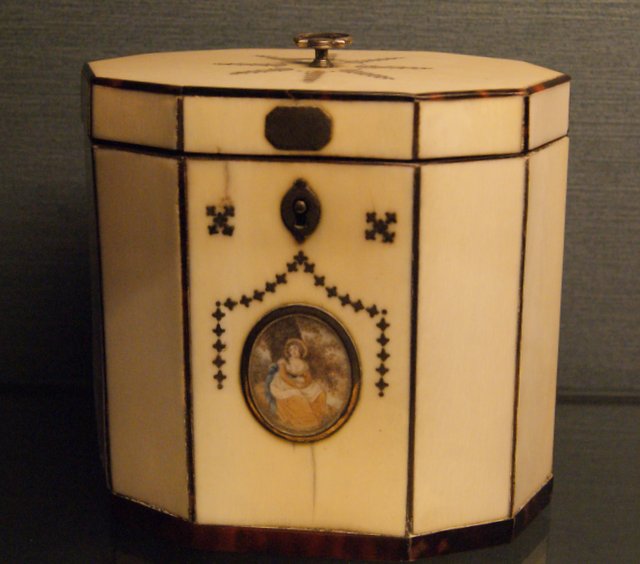
Tomas Twining bought Tom’s Coffee House on this site, virtually on the border line between the City of London and the City of Westminster, and began selling tea alongside the highly popular coffee. Tea was incredibly expensive, thanks to very high taxation, but Twining persisted. Perhaps because of the high price tea soon acquired a certain cachet and became fashionable. Tea caddies came equipped with locks to stop the servants pilfering it and there was a brisk sale of used and re-dried tealeaves – one of the traditional perks of Cook who would sell them at the door after the families used tea had been recycled for the servants a few times.

The use of damp tea leaves to freshen and clean carpets dates from the Victorian era when the tax had been abolished – it was far too valuable for a Georgian housekeeper to use in that way.
The Austen family bought tea from Twining’s. In March 1814 Jane, who was visiting her banker brother Henry, wrote to Cassandra. ‘I am sorry to hear there has been a rise in tea. I do not mean to pay Twining till later in the day, when we may order a fresh supply.’ A few days later she wrote again on a note of indignation, ‘I suppose my Mother recollects that she gave me no Money for paying Brecknell and Twining; & my funds will not supply enough.’

Only the doorway remains of Tom’s, but the interior, besides a vast selection of teas that make choice almost impossible, also has a collection of antique tea caddies, prints, portraits and even original packaging. The Twining’s logo was designed in 1787 and is, apparently, the oldest unchanged trade logo in the world still in use.

The lovely doorcase has the figures of two Chinese gentlemen, a reminder that Indian tea dates from the 1820s when the East India Company began growing it in India to break the Chinese monopoly.
Which do you prefer? Tea, coffee or perhaps chocolate?

Louise Allen
Snowbound Wedding Wishes. Harlequin November 2012

Monday, November 12, 2012

Harlequin Historicals in the Spotlight

Come join twelve Harlequin Historical authors in the Harlequin Community from November 12-16. There's a great discussion going. Ask questions of your favorite authors and join in -- it's fun. Just go to the Harlequin Historical Spotlight Discussion. Here's the URL spelled out if you need it:

http://community.harlequin.com/showthread.php/556-Harlequin-Historical-Spotlight-Discussion

Also, if you're looking for Christmas recipes, try the Harlequin Christmas Cookie Recipe Exchange. There are already a bunch of great recipes there. Here's the URL spelled out:

http://community.harlequin.com/showthread.php/743-Harlequin-Christmas-Cookie-Recipe-Exchange

Hope to see you there!


Tuesday, November 06, 2012

Having Fun with Festive Customs


Writing a festive romance set in Scotland I was, quite literally, in my element. My mother’s family hail from the Isle of Lewis, a brooding and romantic landscape awash with ancient traditions and customs, some of them pre-dating Christianity. When I was a wee lassie, my maternal grandfather, a sea captain, filled my head with his stories of selkies and mermaids, sea sirens and sea ghosts. I was terrified and fascinated in equal parts. It seemed to me that the high seas were chock full of creatures (mostly women and often in the form of seals) who spent their days trying to lure poor innocent sailors to their death.

My Nana, who was a herring girl in her youth, was even more superstitious. It seemed that the wee people, or faeries, had it in for bairns on the islands every bit as much as the sea sirens had it in for sailors. Faeries were always on the lookout for new borns, which they would replace with their own changlings if they got half a chance. During childbirth, mirrors were covered to stop them stealing the baby’s image, and a cross of rowan was laid on the birthing bed to scare them off. When the mother was ‘churched’ after the birth, hot coals and peat were thrown behind the procession to make sure no faery could follow. Making a cradle from sacred woods such as elder, oak or rowan would keep the babe safe, as would the father’s dirk, or dagger, placed under the bairn’s pillow.

My maternal grandparents, whose stories inspired several of mine
The fairies my Nana talked about were not, you’ll have gathered, the pretty, playful wee things you see in story books. Many Scottish New Year traditions have at their root this need to keep the mischief-makers, sometimes called Kelpies, out of the house. Take the obsessive cleaning that still goes on, for example. The house must be gleaming, and I mean gleaming, when midnight strikes. Not a dust mote under the beds, not a teaspoon in the sink can there be, for it would mean a dirty home for the rest of the year, and the dirt gave a faery somewhere to hide.  

Clootie dumpling. a Scottish delicacy!
Rowan brings luck, and hazel wards off evil spirits. Both of these are traditionally hung over the front door on Hogmanay. The door is opened as midnight strikes to let out the old year and let in the new, so the rowan and hazel make sure that no wee people can dive in. Sometimes the old year is literally swept out the door.
An Invitation to Pleasure, my latest ‘Undone’ short story, takes place over Christmas and New Year, and contains a lot of customs, not all of which are Highland. The stirring of the pudding is actually a an English tradition which I adopted. Fergus and Susannah, my hero and heroine, stir a Clootie dumpling, which was my paternal grandmother’s speciality. Made with suet, treacle and rich with fruit, it is cooked in a muslin (actually, my Gran used an old pillow case) and can be eaten hot with cream or custard, or fried up for breakfast. My Gran made me one every year for my birthday. I loathe dried fruit of any kind, but every year I’d smile happily and nibble daintily, then pass the whole lot to my mother – who loved it. Gran put sixpences and thruppences in the pudding for luck. When we went decimal, it just wasn’t the same.

The bundling board, a huge bit of wood which divides up the bed Susannah and Fergus sleep in, is another real Highland tradition. Unlike my hero and heroine, the courting couples were, in reality, fully-clothed, in fact the lass’s legs may even have been tied up in a bolster cover just to keep her ‘safe’, but bundling was an accepted custom in the days when courtship was long and drawn-out while the couple saved to marry.
Feet washing is another Highland custom that I adapted. Traditionally, the groom’s feet are washed by his friends the night before the wedding. It’s a raucous and by the sounds of it painful ceremony involving boot-blacking and scrubbing brushes. I thought it would be much more fun to have the groom wash the bride’s feet though. Fergus uses wine and not water to bathe Susannah’s feet, and this part of the ceremony is true to tradition – wine instead of water being used for high-ranking men such as the laird. The other part of the ceremony, relating to a ring – now that, I did make up.

Christmas Day here in Argyll two years ago 
Christmas Day itself in the Highlands used to be much more about the church than celebrating. My mum remembers going to church three times every Sunday when she holidayed in Lewis. There was no cooking, no playing on the Sabbath, no reading of anything but the bible. She was severely chastised for reading a comic once. It is only very recently that ferries have started running, and some woman have even dared to hang out their washing, behaviour so scandalous that it was reported in the press. Christmas Day was definitely not a party day in the Highlands. Which explains why Hogmanay in Scotland is one big party.

After the old year has been swept out, the anxious wait begins for the first foot – the first stranger through the door. A red-head is incredibly unlucky, as is a female. Best of all is a dark-haired man, and if he’s carrying a lump of coal then your luck is made. Black bun is the traditional Hogmanay cake, another of those fruit-rich concoctions that my Gran used to make and I cannot abide, though I’m very fond of shortie. And once that’s all over, it’s ceilidh time – though not, of course, on the dreadful days when New Year’s Day fell on the Sabbath, when the fiddles and pipes had to wait an extra day to be aired.

I had fun using a mixture of real and imagined Scottish festive customs and I hope they lend colour and atmosphere to the story. I’d love to know what  traditions or customs do you hold dear?

An Invitation to Pleasure is out now in the UK, US and Canada in digital format only. My other Christmas story set in the Highlands, Spellbound and Seduced, is available in digital format in the UK, US and Canada, and also in a print anthology (UK only), Sinful Regency Christmas anthology with four other seasonal shorts.

There’s excerpts, background and more about my books on www.margueritekaye.com. I’m always happy to chat on Facebook or Twitter. And if you want to see the ideas and inspiration behind some of my stories then check out my boards on Pinterest

Thursday, November 01, 2012

Today's the day! Nov. 1,  "How to Sin Successfully" is out in stores for anyone who hasn't got it already in a mail order. Check out Riordan's story as he wrangles two wards and  a slew of governesses! Total, sexy fun. Follow this link to the review posted on the good, the bad, and the unread. http://goodbadandunread.com/2012/11/01/review-how-to-sin-successfully-by-bronwyn-scott/#more-20511

Tuesday, October 23, 2012

A Motto to Live Up To

WE HAVE A WINNER! The download of A Lady's Lesson in Seduction goes to commenter Katherine White.

Several years ago I visited Gawthorpe Hall in Lancashire, England. It’s a beautiful old house and well worth the visit. It started as a peel tower in the 14th Century, but the house as it now stands was constructed mostly in the Elizabethan age and renovated extensively in the 19th Century. Its history is connected with the witches of Pendle Hill, and Charlotte Bronte was twice a guest there.  


I spent quite a while squinting up at the mottoes on the central tower. One of them reads Prudentia et Iusticia. Even I, with my meagre Latin, could guess that it translates as Prudence and Justice. The other motto looks like Old English to me:  Kynd Kynn Knawne Kepe. I’ve found a few translations: Keep your own kin-kind or Kind friends know and keep, or perhaps Take care of your own


I’m not sure how I got from these mottoes to the entirely different one plaguing my hero, Camden Folk, the Marquis of Warbury, in my Christmas novella, A Lady’s Lesson in Seduction. Maybe it’s because Gawthorpe House is Elizabethan, like my hero’s – but Camden lives much farther south, in Oxfordshire. Perhaps it’s because I’ve always wondered how it felt to have a motto, and thought what a burden it might be if one felt compelled to live up to it.    
 
For Camden, living up to the Folk family motto presents an unusual problem. The first part of the motto is missing and has been for centuries, since before the house was built. All that’s left is Secundum, Non Nocere, which translates as Secondly, Do No Harm. Camden has no idea what he’s supposed to do first…although he and his cousins had fun dreaming up first halves for the motto when they were children.

Even though the Marquis has quite a reputation with the ladies, he always does his best to live up to the second half of his family motto and harm no one. This becomes a challenge when in a good cause (or so he sees it), he takes on the seduction of his friend’s widow, the lovely, vulnerable Frances Burdett. The story is full of Christmas customs and even has a wee hint of magic.

Here’s a blurb:

Once a notorious rake, Camden Folk, Marquis of Warbury, is now consumed by desire for only one woman: beautiful young widow Frances Burdett. The Yuletide festivities at his country estate present the perfect opportunity for seduction…

After her brief, unsatisfying marriage, Frances swore never to become tied to another man. Then a passionate kiss under the mistletoe reawakens longings she thought buried forever. Can she give in to the pleasures of the body with a rogue like Cam—without losing her heart?


And an excerpt:

Frances should never have agreed to go to the orchard with the Marquis of Warbury—to gather mistletoe, of all things. She sent him a fierce, furious glare. “If you must have it, I don’t enjoy kissing.”

He eyed her from behind the apple tree. “Not at all?”

“No.” She pressed her lips together.

“Come now,” he teased. “Surely you’re exaggerating.”

Her voice was low, suffused with passion. “You can’t possibly judge how that—that invasion made me feel.”

“That bad, was it?” The marquis reached up and snipped with his shears. “You’re right, I can’t judge, but the general popularity of kissing tells me you were merely unlucky.” He came around the tree, a sprig of mistletoe in his hand.

What a fool she was; in spite of bitter experience, she wanted to kiss him, wanted kissing to be wonderful. How stupid! She was much better off—much safer—as she was.

He kissed the fingertips of his gloves and blew. “That wasn’t so bad, was it?”

Frances huffed.

He picked a berry from the mistletoe and dropped it. “We’ll make it a very light kiss,” he said, coming closer. “Short and sweet.”

She didn’t trust him; she wanted yet didn’t want—

A flurry of snow tumbled from the branches above, distracting her. He swooped in, dropped a swift, cold kiss on her lips, and drew away—but not far. “Was that too unbearable?” Another mistletoe berry fell to the snow.

“No, of course not,” she said, “but—”

“Well, then.” He took her hand and pulled her behind the tree. “If you don’t want me to invade you—accidentally, needless to say—you’ll have to keep your mouth shut.”

“You mustn’t do this—”

“Of course I must. No talking.”

She gave up, shutting both her mouth and her eyes. It was her own fault for coming to the orchard this morning, but she’d enjoyed their time together in the middle of the night so very much. It was only a kiss.

Nothing happened. She opened her eyes again. He was contemplating her mouth from under his lashes. “You have lovely lips.”

Through her teeth, she said, “Get it over with.”

“I’ve never kissed a martyr before.” His lips curled in a lazy smile, and then he pressed his mouth coolly to hers and withdrew again. “It requires a more careful approach than we disgustingly hasty men are used to.” He flicked another berry off the sprig.

She couldn’t help but watch his mouth. What was he going to do, and when?

“Close your eyes, and whatever happens, keep your lips together.”

This time his mouth lingered on hers a few seconds, then pressed light kisses from one corner of her lips to the other. Kiss. “One.” Kiss. “Two.” Kiss. “Three.”

Bite.


***
   
Any ideas of what the first half of the motto should be? Any suggestions of other stately homes I should visit on my next trip to England? Favourite Christmas customs you’d like to see in a story? I’d love to give away a download – for Nook or Kindle – to someone who comments here.


Wednesday, October 03, 2012

The Man Who Broke the Rules


Over on the Harlequin Community blog at the moment, there’s an excerpt posted from the November 1816 edition of Derby Mercury. Admittedly it’s not a genuine excerpt (it was in fact written by me!), but it contains a fascinating account of the visit of a Mr Virgil Jackson to Castonbury village school. A visit which features in my story in the Castonbury Park series called The Lady Who Broke the Rules.

Lady Katherine Montague, scarred by her failed betrothal, shunned by society as a result, decides to pour all her energy into philanthropic causes – such as the establishment of a village school. Virgil Jackson, my freed-slave hero, is determined to use his hard-earned wealth to provide the opportunities for other slaves which he struggled so hard to earn. So naturally he’s interested in Kate’s school. His interest in Kate herself, however, is something he’s less keen to admit to.

Kate’s village school takes its inspiration from Robert Owen’s model village in New Lanark, not too far from Glasgow where I went to university and made my home for several years. Finding my day job at the time pretty unexciting, I started studying history with the Open University, and it was one of my tutors here who first introduced me to New Lanark. I was, from the start, fascinated by it’s creator’s vision.

If you ever get the chance, the village and the beautiful Falls of the Clyde, which were the powerhouse driving the mills, are well worth a visit. It was established by David Dale in 1786 to provide homes for his cotton mill workers, but it was Dale’s son-in-law, a Welsh philanthropist called Robert Owen, intent on testing out his ideas for social reform, who was the real trail-blazer.

I’ve learned enough about Owen to suspect that he would be quite a difficult man to like, but then social reformers need to be strong-willed and single-minded, don’t they? Owen possessed such a singular vision as to make anyone else’s views on any matter – well, irrelevant. He was very religious and very moral, with an incredibly strong work ethic – so woe betide any slackers or back-sliders in his work force. Basically, I think it would have been  his way (which became known as utopian socialism) or the highway – but what a revolutionary way it was.

New Lanark.Photo Credit Stara Blazkova via Wikipedia 
Most of the mill workers came from the poorhouses of Glasgow, some from the slums of the city’s east end, with a good dash of Highlanders on the run from the dying embers of the Clearances. In New Lanark, they lived in tenements, many with just one room per family, but even this was a vast improvement on what they’d left behind. The actual working conditions at the mills were good in comparison to other such places, with less injuries and fatalities, good ventilation and so better general health. And Owen’s workers didn’t just get on-site accommodation – provided they toed the company line which insisted on regular attendance at church – there were a host of other benefits. Their children were educated at a school which was not only heated, but at which learning was intended to be fun. Then there was the Institute for the Formation of Character, through which Owen hoped to demonstrate in practice his theory of practical determinism – basically, that character can be formed and is not innate. The institute opened in 1816 and became the focus for education in the village – for all ages, with classes of all types including drill, dancing and instructional lectures.

Robert Owen left New Lanark for the new world in 1824, where he established the Community of Equality of New Harmony in Indiana. In my story, Kate is inspired by Owen’s book, New View of Society, and Virgil, who visits Owen, although he has some reservations, is also inspired enough by the underlying philosophy  to spend some of his own wealth on establishing another such community.

It astonishes me sometimes how people I’ve admired, characters I’ve read about and places I’ve visited in my own past find a place, almost by osmosis, in my stories. I do wonder though, what on earth my austere Open University professor would make of finding his beloved New Lanark featuring in a Harlequin romance. Do you have a favourite person or place from your past you’d love to see feature in a romance?

The Lady Who Broke the Rules is out now, print and digital in the UK, digital only in US and Canada, though it will be released in print as a duo in December.  

'Your rebellion has not gone unnoticed...' Anticipating her wedding vows and then breaking off the engagement has left Kate Montague's social status in tatters. She hides her hurt at her family's disapproval behind a resolutely optimistic facade, but one thing really grates...For a fallen woman, she knows shockingly little about passion! Could Virgil Jackson be the man to teach her? A freed slave turned successful businessman, his striking good looks and lethally restrained power throw normally composed Kate into a tailspin! She's already scandalised society, but succumbing to her craving for Virgil would be the most outrageous thing Kate's done by far...

Castonbury Park
Flirting with Ruin (Undone! Prequel) - Marguerite Kaye, June 2012
The Wicked Lord Montague - Carole Mortimer, August 2012
The Housemaid’s Scandalous Secret - Helen Dickson, September 2012
The Lady Who Broke the Rules  - Marguerite Kaye, October 2012
Lady of Shame - Ann Lethbridge, November 2012
The Illegitimate Montague - Sarah Mallory, December 2012
Unbefitting a Lady - Bronwyn Scott, January 2013
Redemption of a Fallen Woman - Joanna Fulford, February 2013
A Stranger at Castonbury - Amanda McCabe, March 2013

There are excerpts, background and more about Castonbury Park and all my other books on www.margueritekaye.com. I’m also always happy to chat on Facebook or Twitter

Friday, August 10, 2012

The Marriage Mart - It Wasn't All Almack's


One of the abiding images of Regency life (alongside that of the Prince Regent’s waistline expanding to match the domes at the Pavilion) is of anxiously scheming mamas and of fathers sighing over the dressmaker’s bills as their daughters entered the polite shark-pool that was the Marriage Mart.
To obtain vouchers for Almack’s was the pinnacle of ambition of course, but what if you couldn’t afford a Season in London? How were you to find an eligible husband for the girls? The answer was your closest market town with its modest theatre and, most importantly, its Assembly Rooms.
Sometimes these were purpose-built, sometimes the town’s largest inn would have a room of sufficient size to host dances. It is not clear which variety was the setting for the ball at which Miss Elizabeth Bennet was so comprehensively snubbed by Mr Darcy but the room obviously had plenty of space for seating the young ladies who, like Elizabeth “…had been obliged to sit down for two dances…” due to a shortage of gentlemen.
Dancing was not always an elegant and refined affair. Many of the measures were country tunes and ladies could find themselves quite overcome by the heat and effort as this delightful drawing of 1816 above shows.
Balls would be held on moonlit nights so that carriages from the surrounding countryside could travel safely, although if they came from any great distance they would probably put up at a respectable local inn or stay with friends or relatives in the town. Longbourn was obviously close enough for the Bennets to make the return journey that evening and in time to find Mr Bennet still up, reading in his study.
I was in Swaffham, a busy little Norfolk market town, the other day. Usually we drive straight through on our way towards London, but this time we stopped and explored and I realised there was much more to it than I had realised – it has been called the finest predominantly Regency town in East Anglia.  This part of Norfolk in the 18th and early 19thc was one of the richest in England, a wealth built on agriculture and trade by sea, river and road into London. Grain, cattle and poultry all grew abundantly and it was from this area that thousands of turkeys and geese, their feet protected by “boots” of tar, were walked into London in time for Christmas.
As a result the local gentry had money to patronise assemblies, routs, theatre performances and shops; they had daughters to marry off and now they had good roads and well-sprung carriages to make local travel easy and comfortable.
The streets around Swaffham’s central market square with its elegant rotunda (1781) topped by the goddess Ceres with her sheaf of wheat are as lined with handsome Georgian houses as the floor of the large church is with the flamboyantly carved ledger slabs of the local gentry.
Swaffham had a flourishing theatre which would act as the venue for the travelling players working their circuit around the market towns of East Anglia. In 1806, Lord and Lady Nelson stayed in the town with their daughter Lady Charlotte and Nelson’s mistress, Lady Hamilton and her daughter, Horatia Nelson Thompson. That shocking ménage must have caused a certain twitching of the curtains and thrilling gossip for the local ladies! While they were there they “bespoke” the play She Stoops To Conquer at the local theatre which must have greatly gratified the players. Nowadays there is no sign of the theatre, although Theatre Street remains.
By 1817 the demand for social events was so great that an Assembly Room was built and it is still there, a sad shadow of it its former self, disfigured by internal alterations in the 1960s and ugly 20thc extensions. It can be seen in the background of the photograph of the market square, the depressed concrete-faced low building behind the market stalls.
As well as the church there is also a large Methodist chapel built in 1813, an indication of the strength of non-conformity in the area if such an imposing building in a prime site could be afforded by the local congregation. At the same time older buildings were being refaced and “modernised”. Then with the agricultural depression of the later 19thc things began to decline. The Assembly Rooms lost their elegance, the theatre vanished, the gentry who could afford it could reach London by train. Now Swaffham is bustling again and the elegant buildings of its Regency heyday are taking on new uses – shops, a museum, even a Russian restaurant!
Do you have a favourite place where it is possible to dig beneath the modern face to find a fascinating history?

Louise Allen
www.louiseallenregency.co.uk

Monday, August 06, 2012

Using one Medieval Palace to help build another...

Betrothed to the Barbarian is set in Byzantium in the eleventh century.   Much of the story takes place within the walls of the Imperial palace complex, known as the Great Palace in Constantinople.

Constantinople as such no longer exists (it is now Istanbul) and at first glance it's not easy finding out what the Great Palace might have been like.  It certainly took up a lot of space, and most of it lies beneath modern Istanbul.  It was sited on the peninsular bordered by the Sea of Marmara and the Golden Horn.     A city in itself, there were dozens of buildings in the Great Palace, which included residential palaces, baths, stables, a garrison, banqueting halls, churches.  There's even a polo ground - the hero of this novel is a keen polo player...

There are maps that give an idea of the scale of the Great Palace.  The one below is from Wikipedia.  The Imperial Palace was separated from the rest of the City by vast walls.  It was guarded day and night.  You can see from this section of the map that some of the buildings overlooked the sea.  The women's quarters, where Princess Theodora has her apartment, is in this area of the palace - it was known as the Boukoleon Palace.


Since not much of the Imperial Palace complex is left today, a recent visit to the Tower of London proved fruitful when it came to imagining some of the furnishings that might have been found in the Imperial apartments.
As one would expect, there's a distinctly twelfth century look to the Tower of London furnishings and the colours - red rather than Imperial purple - are not quite right, but they do give a feeling of luxury.
There are paintings on the walls.  In the Great Palace, some of the walls would have been painted, others would have been glittering with mosaics.

The last picture shows a painted shutter.  Shutters have been used for centuries to keep out the wintry blasts, and they would be equally useful in a palace overlooking the Sea of Marmara as in one overlooking the River Thames!

For more about Betrothed to the Barbarian, please see the monthly release list for August, or visit my blog site: Carol Townend.